Masakazu Takano
Kitan Club, November 1952
[Translator Notes: This article has been translated from a 1952 Japanese erotic magazine called Kitan Club, and the author is probably using a pseudonym, as it was published for a subculture that saw a great deal of social suppression in Japan. It was translated with no intent to editorialize, so the wording and opinions reflect that of the author, the era, and the culture of which it is written.]
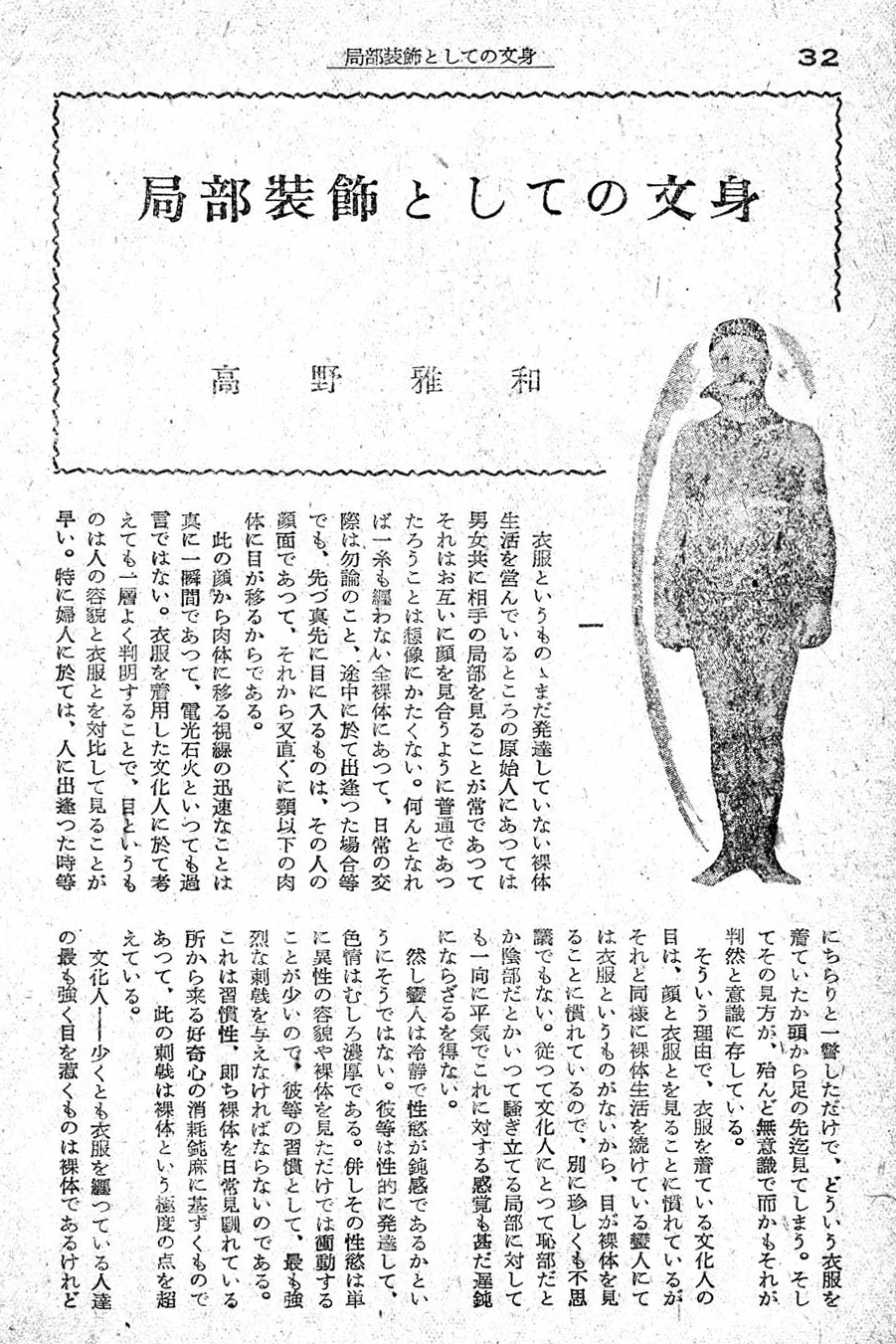
As for clothing, it is not difficult to imagine that among primitive people living a naked existence where clothing had not yet been developed, it was common for both men and women to see each other’s private parts, just as it was natural for them to look at each other’s faces. This is because, in a state of complete nudity, the first thing that catches the eye, whether in daily interactions or when encountering someone unexpectedly, is the person’s face, and from there, the gaze immediately shifts to the body below the neck.
The speed with which the gaze moves from the face to the body is truly instantaneous, it would not be an exaggeration to describe it as lightning-fast. This becomes even clearer when considering cultured people who wear clothes, the eye is quick to compare a person’s appearance with their clothing. This is especially true for women. When they encounter someone, even with just a fleeting glance, they take in what clothes the person is wearing from head to toe. And this way of looking is almost unconscious, yet it remains distinctly present in their consciousness.
For this reason, while the eyes of clothed civilized people are accustomed to observing both the face and the clothing, those of eccentrics who continue to live in the nude, since they have no clothing, are accustomed to seeing the naked body, so it is neither strange nor mysterious to them. Consequently, even regarding the parts that civilized people make a fuss about, such as the “private parts” or “genitals,” they remain completely unperturbed, and their sensitivity to these areas inevitably becomes extremely dulled.
However, this does not mean that these people are calm or sexually insensitive. They are sexually developed, and their eroticism is, if anything, intense. However, since their sexual desire is rarely aroused merely by seeing the face or naked body of the opposite sex, their custom requires that they be provided with the most intense stimulation. This is based on a habit, specifically, the exhaustion of curiosity stemming from daily exposure to the naked body. And this stimulation goes beyond the mere state of nudity.
For cultured people, at least those who wear clothes, the nude is what most strongly attracts the eye, but as mentioned earlier, for nudists living a nude lifestyle, it is extremely weak. For this reason, for primitive humans, the stimulus that provokes and excites their sexual desire must be something other than the nude body. Therefore, it is for this reason that these eccentrics adorned their exposed body parts with various decorations to attract the eyes of the opposite sex, naturally, their purpose was courtship.
This custom of decorating such private parts to attract attention gradually evolved, leading on the one hand to the development of clothing and on the other to the development of tattooing.
2.
The purposes of tattooing practiced by various peoples around the world can be broadly categorized into three types; intimidation, decoration, and courtship. Tattoos were used to display bravado and intimidate enemies, to adorn the body and satisfy vanity, or to attract the attention of the opposite sex and entice them. Although the purposes of tattooing vary in this way, their fundamental origin lies in sexual impulses that gradually evolved into an art form.
Of these three purposes, courtship is the most primitive. The other two also stem from sexual impulses, and the origins of tattooing truly lie here. It is clear that tattoos on the face and other parts of the body evolved from tattoos on specific body parts. Primitive people applied ink to their genitals to attract the gaze of the opposite sex. Eventually, this evolved into tattooing the genitals to express this desire even more vividly and to indicate its location.
Therefore, the purpose of a tattoo can be determined by its location. For example, when intended for sexual desire or decoration, tattoos are primarily applied to the genital area, extending to the thighs, lower back, and lower abdomen, whereas those intended to intimidate enemies are applied primarily to the face, as well as the back and chest.
Today, ethnic groups that regularly practice genital tattooing include the indigenous peoples of the South Pacific, such as those in Polynesia, the Yap, the Barao, and the Bonape Islands, as well as American Indians and the Rieknoul tribe of Africa.
On Yap Island, there are three types of tattoos based on the location where they are applied, those covering the entire body are called “Yol” (Type A), those applied from the wrist to span’s length are called “Berao” (Type B), and those applied from the groin to the ankle are called “Selbuteya” (Type C). This is related to social class. Class A is divided into the first through third grades. Class B is applied across all classes, and Class C is divided into the first through fourth grades.
While this is primarily practiced on men, there are two types of tattoos for women, those applied to the forearms and fingers, and those applied primarily to the genital area, extending from the navel to the center of the thigh.
Tattooing is also prevalent on Belau Island, where girls typically begin getting tattoos around the age of twelve or thirteen. An interesting practice involves post-marriage tattoos, specifically triangular tattoos applied to the genital area. It is said that this is done to maintain the husband’s affection. The practice on Ponape is roughly the same. Once a girl comes of age, she undergoes tattooing centered on the genital area, extending from the waist to the feet in a bad-like or linear pattern.
All the South Pacific islands are places where tattooing is most highly developed, and among the Yaori tribe of New Zealand, for example, it is extremely prevalent. The chief of this tribe has his entire face tattooed, projecting an imposing presence, with almost no skin left untouched. These tattoos are also linear in nature, which is a characteristic feature of the South Pacific.
Furthermore, it is a well-known fact that the indigenous peoples of Taiwan and the Aima people are tribes that have long favored and practiced tattooing, so there is no need to elaborate. However, in both cases, only women undergo the practice, and the method is similar. Specifically, they are tattoos around the mouth. The women of the indigenous tribes have tattoos radiating from the corners of their mouths toward their ears, while the women of the Aima tribe have tattoos running diagonally upward from the corners of their mouths, though not in a radiating pattern as seen among the indigenous tribes.
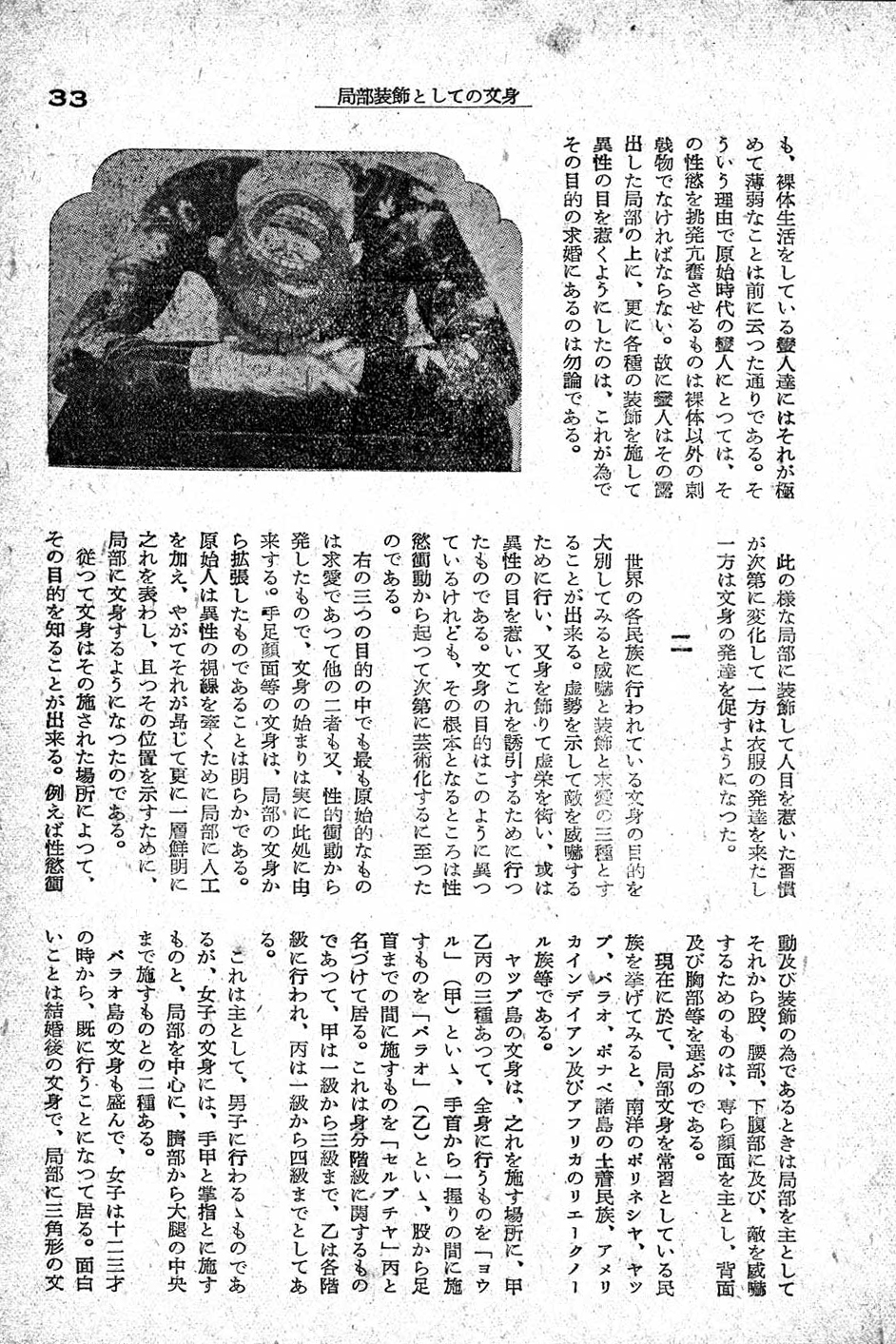
The tattoos practiced among the Haida Native Americans are not of the South Pacific linear type, rather, they mostly depict human faces, animals, plants, or tools, and these designs are identical for both men and women. Furthermore, among the Rukunol tribe of Africa, both men and women tattoo their private parts equally, in order to attract the attention of the opposite sex. In some cases, people wrap pieces of cloth dyed in various vivid colors around their waists as a substitute for tattoos. It is said that when a British traveler named Martens once asked a member of the Luknool tribe, why did they did this, the person replied that it was to attract the attention of the opposite sex, just as Europeans wear beautiful clothes.
Furthermore, some forms of tattooing stem from a veneration of the genitals. This involves tattooing or carving the genitals of the opposite sex onto one’s own body, a practice found among the Polynesian peoples. It is not necessarily limited to the genital area itself, but may also appear on nearby areas such as the chest or limbs. At times, such tattoos are applied as a memento after the death of a lover.
3.
Tattooing is practiced not only by indigenous people, but also by civilized peoples. It is a remnant of primitive customs. However, there is a form of tattooing practiced by a specific class of people, though it may seem odd to speak of a “specific class” among civilized peoples, and this term refers to those who lead a lifestyle distinct from that of ordinary people.
Those belonging to this special class include criminals, outlaws, reformed vagrants, and prostitutes. In our country, there were also figures known as “kumosuke.” These individuals take special tattoos as a source of pride, and generally speaking, the tattoos practiced by the Japanese are of a special nature.
Thus, as evidenced by historical records, tattoos were associated not with ethnicity but with specific social classes, and were commonly practiced among such groups.
It seems that many female thieves in the past were tattooed. Female outlaws, poisonous women, and wanton women depicted in rakugo and novels often had beautiful tattoos extending from their backs to their upper arms. Examples include Hitana Oito, Mamoru Omaku, and Onigami O-Matsu. In fact, a piece of Hitana Oito’s tattooed skin was once exhibited at the Women’s Exhibition in Ueno.
Furthermore, outlaws, professional criminals, and vagabonds also favored tattoos, primarily on the back and abdomen, followed by the buttocks, thighs, and arms, often covering the entire body. The designs, vividly colored depictions of figures, demons, animals, and other eye-catching subjects, are applied in such a way that, when the body is bared, the sight is akin to viewing a painting.
However, Japanese tattooing tends to avoid the face and private parts. The reason for this is likely that the Japanese dislike having scars on their faces, and they have a strong sense of shame regarding their genitals, even the lowest-class people, and in extreme cases, even prostitutes, keep their genitals hidden and feel ashamed to have them seen by others. This is the reason why Japanese people avoid tattooing their faces and private parts. Nevertheless, they apparently believed that tattoos on other pats of the body would attract the attention of the opposite sex.
4.
Among tattoos, those depicting a close connection to sexual desire are those depicting erotic paintings or obscene literature. These are common among women engaged in prostitution. Although they are considered a low art form, they are of great interest as a distinctive feature of prostitutes and as a motivation for sexual impulses. This is because there is an inseparable connection between the life of a prostitute and sexual desire, and they sought to further enhance their own sexual appeal. Consequently, some of them deliberately tattooed their private parts to please the clients’ eyes, using them as tools to arouse sexual desire.
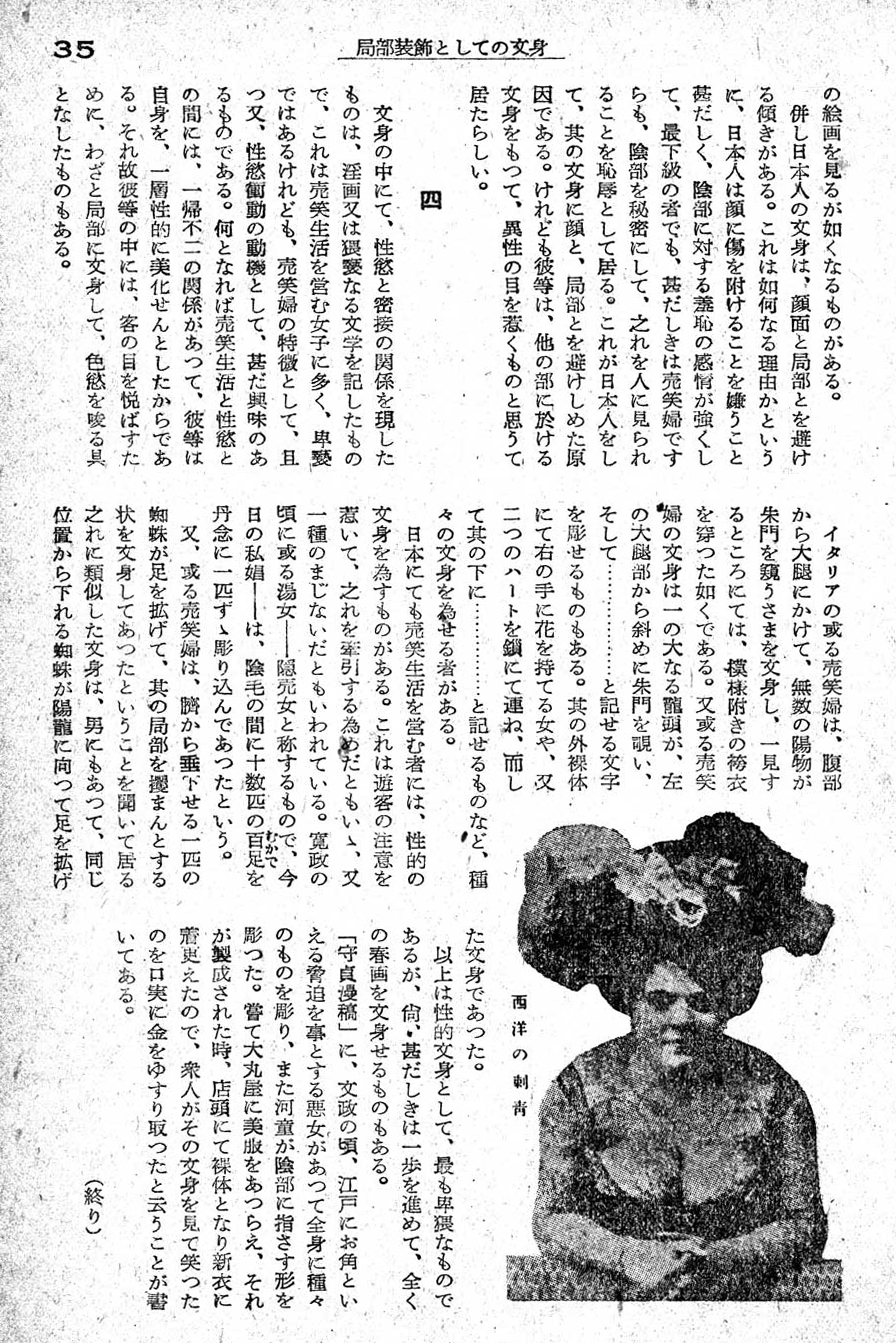
One Italian prostitute had countless phalluses tattooed from her abdomen to her thighs, peering toward her vulva. At first glance, it looked as if she were wearing patterned trousers. Another prostitute had a large phallus tattooed peering diagonally toward her vulva from her left thigh, accompanied by an inscription of specific text. Furthermore, there are various other tattoos, such as a nude woman holding a flower in her right hand, or two hearts connected by a chain, beneath which was inscribed yet another message.
Even in Japan, some women engaged in prostitution have sexual tattoos. It is said that this is done to attract the attention of customers and lure them in, or that it is a form of magic. During the Kansei era, a certain bathhouse worker, known as a “yuna,” a type of unlicensed prostitute (known as “kakushi-baishunjo”), akin to the private prostitutes of today, was rumored to have had over a dozen centipedes meticulously tattooed, one by one, amidst her pubic hair.
I have also heard of a prostitute who had a tattoo depicting a spider hanging from her navel, its legs spread wide as if about to seize her private parts. A similar tattoo existed among men as well, a spider descending from the same location, its legs spread toward the penis.
The above examples are the most obscene of the sexual tattoos, but there are even more extreme cases where people go a step further and have outright pornographic images tattooed on themselves.
According to “Morisada Manko,” around the Bunsei era, there was a wicked woman in Edo who made a living as a blackmailer known as “O-Kaku.” She had various things tattooed all over her body, including a design of a kappa pointing at her genitalia. It is written that she once had a beautiful design made at Daimaruya. When it was completed, she stripped naked in the shop and changed into new clothes, using the fact that the crowd laughed at her tattoos as an excuse to extort money from them.